

German Chocolate Cake Frosting
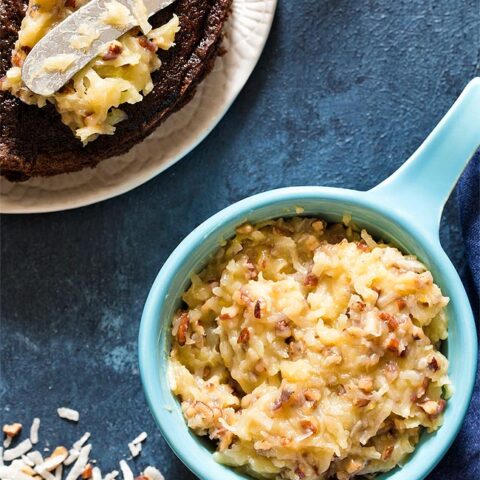
Looking for the best coconut pecan frosting recipe without leftovers? Look no further than this German Chocolate Cake Frosting made without evaporated milk! Makes enough to frost small batch desserts such as 6 inch cakes.
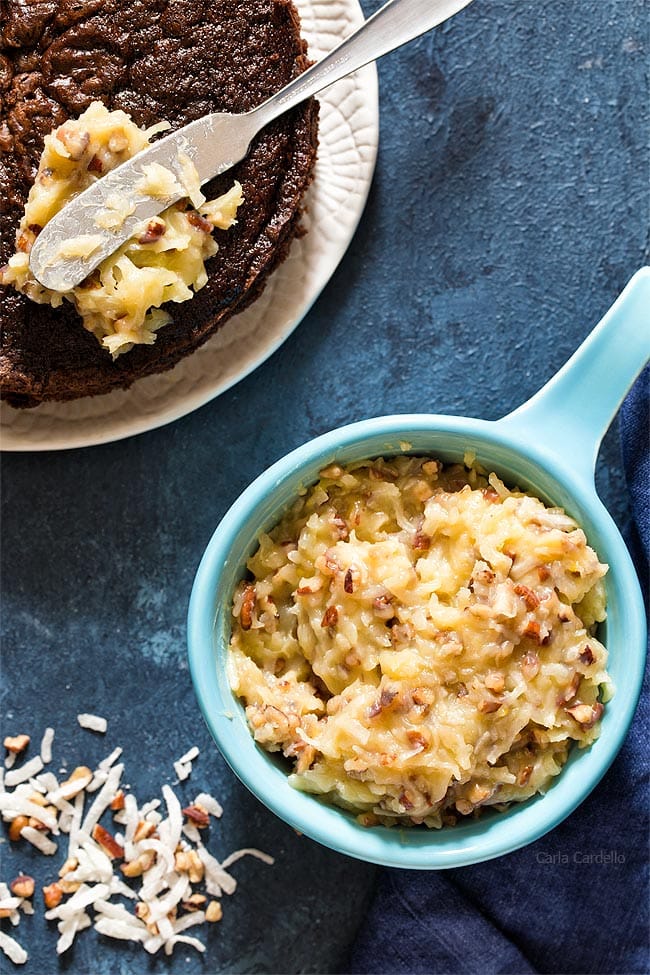
To say I love German chocolate desserts like my German chocolate pecan pie is probably an understatement.
As I was going through my recipes, I noticed I repeated the same recipe for German Chocolate Cake Frosting over and over again.
Rather than constantly repeating myself and having answers to questions all over the place, I decided to write a dedicated post to it.
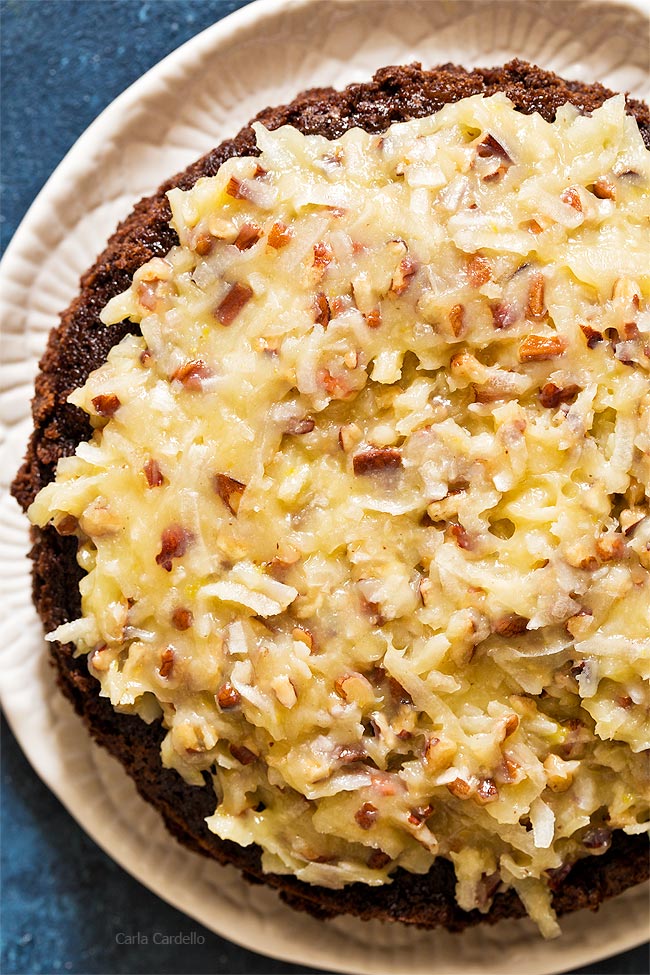
German chocolate frosting is a thick and creamy coconut pecan frosting that despite its name isn’t German. It’s actually named after the type of chocolate used in the cake.
Typically you use it to frost German chocolate cake, but I’ve also used it as a filling for German chocolate cookies.
Unlike small batch buttercream frosting, you don’t pipe it. You spread it onto your mini German chocolate cake with an offset spatula.
In order to spread it, it has to be thick. Instead of beating in powdered sugar, German chocolate frosting is thickened by boiling together a few ingredients then cooling until a spreadable consistency.
Most German chocolate cake icing recipes use canned evaporated milk, which unless you’re using the whole can at once, is annoying for small batch baking. I mean, what DO you do with the leftovers?
However, my homemade German chocolate frosting recipe is different (and better, ahem) because I found a way to substitute for that with an easy pantry (er refrigerator?) ingredient.
Why You’ll Love This German Chocolate Frosting Recipe
- Made without evaporated milk! – Nobody wants to open canned evaporated milk just to use a few tablespoons.
- Uses up an egg yolk! – If you have a yolk leftover from making my flourless chocolate cookies, then you’re one ingredient closer to making this frosting.
- Makes a small batch! – No more throwing away leftover frosting. Perfect for small cakes, small batch cupcakes, and more.
Ingredients For German Chocolate Cake Frosting
Here’s what you need to make your coconut pecan frosting for German chocolate cake:
- Sugar: Balances the sweetness while also caramelizing when cooked
- Heavy cream: Makes for a creamy frosting
- Egg yolk: Thickens the custard-like base similar to thickening ice cream
- Butter: Provides richness
- Salt: A touch helps bring out the other flavors
- Coconut: I used sweetened coconut flakes which is the most common coconut found in the baking aisle.
- Pecans: Adds a nutty, crunchy element to your otherwise soft frosting
- Vanilla: Enhances the flavors
Since you’re using an egg yolk, check out my recipes to use up leftover egg whites.
How To Substitute Evaporated Milk In German Chocolate Frosting
Traditionally German chocolate frosting is made with canned evaporated milk. However, that’s not an item I normally keep in my pantry so I found a way to easily substitute it.
To substitute for evaporated milk in coconut pecan frosting, use heavy whipping cream.
Evaporated milk is milk that has been boiled down to reduce, or evaporate, the water content (hence the name). This results in a slightly thicker milk than regular dairy milk.
Although heavy cream isn’t the same as evaporated milk, substituting it still achieves the same effect – a creamy thick frosting.
Don’t know what to do with the rest of your cream? Here are some recipes using leftover heavy cream.
How To Make German Chocolate Cake Frosting
Are you ready to learn how to make German chocolate cake frosting? Here’s how:
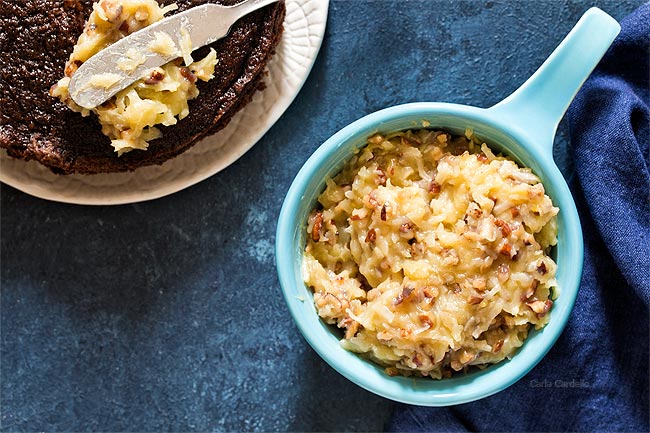
- Whisk together sugar, heavy cream, egg yolk, butter, and salt in a saucepan.
- Boil until thickened.
- Stir in pecans, coconut, and vanilla.
- Cool until spreadable.
Refrigerate leftover frosting for up to 1 week. Let sit out at room temperature for 15-30 minutes or until soft enough to spread.
What To Make With German Chocolate Cake Frosting
Now that your homemade German chocolate frosting is ready to eat, what do you make with it?
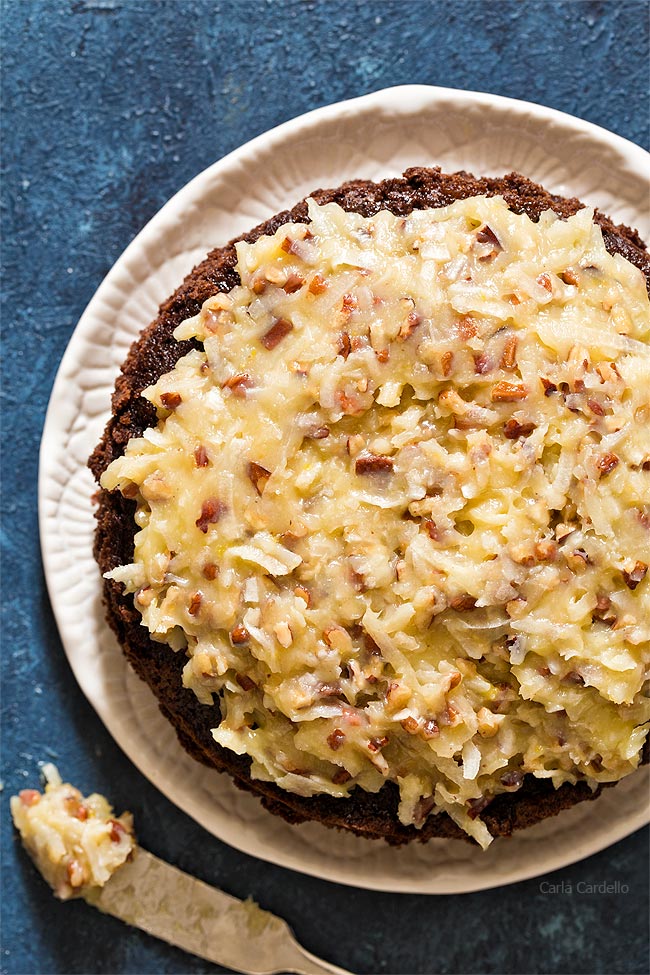
Besides the obvious German chocolate cake as mentioned earlier, you can spread it on top of German chocolate cupcakes or German chocolate cheesecake.
Or mix it into German chocolate ice cream after churning or German chocolate cheese ball before rolling.

More Frosting Recipes
If you enjoyed this coconut pecan frosting, check out my other frosting recipes including:
German Chocolate Cake Frosting
Looking for the best coconut pecan frosting recipe without leftovers? Look no further than this German Chocolate Cake Frosting made without evaporated milk! Makes enough to frost small batch desserts such as 6 inch cakes.
Ingredients
- 1/3 cup granulated sugar
- 1/3 cup heavy whipping cream, room temperature
- 1 large egg yolk, room temperature
- 2 tablespoons unsalted butter, softened and cut into 2 pieces
- 1/8 teaspoon table salt
- 1/2 cup sweetened coconut flakes
- 1/3 cup chopped pecans, toasted
- 1/4 teaspoon vanilla extract
Instructions
- In a medium saucepan, whisk together the sugar, cream, egg yolk, butter, and salt. Bring to a boil over medium heat, stirring often as the butter melts.
- Once boiling, cook until the mixture thickens, about 1-2 minutes.
- Remove from the heat and stir in pecans, coconut, and vanilla. Cool for 1 hour* or until cool and spreadable.
Refrigerate leftover frosting for up to 1 week. Let sit out at room temperature for 15-30 minutes or until soft enough to spread.
Notes
- *To speed up the cooling process: Spread the frosting in a thin layer onto a small cookie sheet or plate. Refrigerate for 30 minutes or freeze for 15 minutes or until cool and spreadable.
- Use this frosting on my Small German Chocolate Cake, German Chocolate Cupcakes, German Chocolate Cheesecake, and German Chocolate Ice Cream.
- Enjoyed this recipe? Check out my full list of Frosting Recipes, including chocolate, strawberry, and more.
Recommended Products
As an Amazon Associate and member of other affiliate programs, I earn from qualifying purchases.
This post may contain affiliate links. As an Amazon Associate and member of other affiliate programs, I earn from qualifying purchase.
What size cake is in the picture ? Would love to make this. It’s my father favorite cake. On his birthday like to have something he like even though he’s gone.It just good way to remember him
6 inch. I’m actually writing up the cake post today and will publish it later this week! That’s a very touching way to remember him. I love it.
Thank you so much.
Thank you for the small batch recipe. It was simple to follow and very delicious. I only had oat milk so I added a little cornstarch to the sugar. Also added a little brown sugar as I had unsweetened coconut.
Glad you were able to make this recipe work for you!
Can you make this 2-3 days ahead of time and just keep it in the fridge? Thanks!
Yes, you can. Bring it to room temperature for about 15-30 minutes so it warms up and becomes spreadable again.
This looks amazing! Do you toast the pecans yourself? If so, how do you recommend to do it?
Yes, you can toast them in a 350F oven for about 8-10 minutes or if it’s too hot out for the oven, you can fry them in a skillet with some butter.
Great, thank you!
Made this last night with the frosting! It is delicious.
Thanks for sharing
Oh wonderful! Glad you enjoyed it.
Cake and frosting were perfect size for my husband’s birthday since it was just the 2 of us. The cake was easy to make and very moist. I could just eat the frosting without the cake. Do you have other small cake recipes? Or ideas on how to ct down funk size batter to make smaller cakes?
Glad you loved the cake! And yes I have a list of all my 6 inch cakes: https://www.chocolatemoosey.com/2019/04/15/small-6-inch-cake-recipes-for-two/
Thank you so much for this recipe…I needed to frost a 9×13 pan cake so I did the following:
I didn’t have evaporated milk or heavy whipping cream so I used 1/3 cup of half and half. I added an extra egg yolk, one tablespoon of salted butter and 1/4 cup of light brown sugar.
I melted the butter first in the pan and then added the sugars, yolks, salt and half and half (I mixed those together before adding to the melted butter), and brought to a boil. I removed from heat and added a 7oz package of sweetened shredded coconut, vanilla, and 2/3 cup of nuts.
Perfect amount for the cake size I had.
Happy to hear you made this recipe work for your cake size.
I had am 8″ cake layer in the freezer leftover from Christmas – I had planned on making cake balls for my cookie platter but the pandemic lockdown changed everynes holiday plans. As much as I love a chocolate cake with chocoate frosting I wanted someting different – I went on a Pinterest search and found your recipe. I didn’t need a full batch since it’s just ane layer and this was the perfect amount….at least it would have been if I hadn’t gone to “test” it to make sure it was good lol. I was afraid it would take a long time to cook it but within 5 minutes from starting it was off the stove and coconut and pecans stirred in ready to cool down. I’ll have to check out your small cake recpes too – as a single girl with a horrendous sweet tooth I sure as heck don’t need the temptation of a full size cake calling me to eat it all lol.
Sorry about the typos….the print was so faint as I was typing it was hard to “proof read” lol
Yes, it doesn’t take long at all to cook. Glad you enjoyed the recipe!
If I was going to use the traditional evaporated milk, would it be the same amount as the heavy cream in your recipe? Would I still need the granulated sugar, or do you add that to sweeten the cream? I made the cake yesterday and am whipping up the frosting today for my grandma’s birthday! Thank you for such great recipes!
It’s the same amount. You would still need the sugar because evaporated milk isn’t sweet. Sounds like you’re thinking of sweetened condensed milk for that.
This was my father‘s favorite cake, in memory of him I plan on making cupcakes with your recipe. Can you please advise how long I should cook cupcakes using this recipe. Sincerely Brenda,
Cupcakes take about 18-20 minutes, depending on your oven.
I cannot wait to try the ice cream with this recipe. I did do a simple search also for what to do with leftover canned evaporated milk, and the lists are large. Now I know.
Enjoy! Let me know how it turns out.
Carla, I just want to commend you on your awesome recipes. I’ve made the 6-inch and it was very scrumptious. I do have one question for you. Do you have a German Chocolate cake recipe for an 8 or 9 inch cake. I’m not good at converting recipes to a larger sum.
No I don’t. The closest I have is my two layer devil’s food cake. You can swap in German chocolate and the coconut pecan frosting. Then you can decide if you want to keep it at two layers or cut in half for one layer: https://www.chocolatemoosey.com/devils-food-layer-cake-with-whipped-chocolate-buttercream-frosting/
Can you carnations milk if you do not have heavy cream?
As long as it’s evaporated milk and not sweetened condensed milk, yes.
I absolutely love this German chocolate frosting, of course the cake too! Delicious! It’s a tie between this frosting and your other coconut frosting recipe. Im glad to have this in a small batch since my husband doesn’t usually eat dessert.
Glad you’re enjoying both frosting recipes!
This was a great recipe, especially using cream instead of evaporated milk. I know it’s a bit cheeky to alter a recipe on the first try but I did substitute 1/3 cup brown sugar and 1 tablespoon of granulated sugar, just because I had been studying a few pence recipes, to which this seems related. Thanks for a great recipe!
Glad you enjoyed the frosting!
I accidentally doubled the flour in a batch of brownies. This simple, small batch frosting saved the day. My coconut was unsweetened, but the frosting was perfect. Thanks Carla!
Glad the frosting saved your brownies!